Quanta
A mobile companion for Tally, built for owners who can’t reach their own numbers.

Overview
Quanta is a mobile companion for Tally — India’s default accounting software for over 2.7M businesses. It gives SMB owners and department heads an at-a-glance view of their business’s financial health, anywhere, anytime. It surfaces Tally data in a form a non-expert can actually read.
Role
End-to-end research & design (sole designer)
Team
1 Designer (me)
3 Developers
Director
Founder
Tally Domain Expert
Tools
Figma
Claude
Duration
4 weeks
Why Three Matter Labs built this
TML runs two products with a deliberate division of labor. Quanta is owner-facing insight and control that earns the daily relationship; Bitamin, TML’s workflow-automation engine, captures the workflow value.
The strategic bet: a huge, underserved base of Tally-dependent businesses whose decision-makers can’t reach their own data. Quanta was built to own that daily touchpoint — the thing that gets an owner to open the app on their own, not because a workflow forced them to.
The Problem
Primary user: Ramesh Agarwal
Owner of a wholesale and distribution business in a tier-2 city.
₹2–3 Cr revenue
Android phone
Low tech comfort
His needs
Stop depending on someone else for business metrics
See who owes him money, and who he needs to pay
Check how sales are going — without asking anyone
A day in Ramesh’s life
Ramesh is out at a client meeting when a supplier calls: “Your payment is due today!” He remembers making a recent payment to this same supplier, but isn’t sure it went through — and Tally’s on the office desktop, in a format he can’t read anyway. He calls his accountant instead. Mid-task, out, or “let me check and call you back.” By the time the number comes back, the moment’s gone. A 30-second answer took half a day.
Why Tally itself doesn’t solve this
Desktop-only, licensed to a few machines
Heavily reliant on accounting terminology
Built for power-users — mainly accountants
Research & discovery
Given a 4-week timeline, I focused research on cadence and priority rather than exhaustive discovery:
Learning the domain — taught myself Tally by shadowing a domain expert and watching how the software is actually operated
4 short interviews — owners and department/sales heads, focused on what they check and how often, not feature wishlists
Secondary research
Competitive analysis
Key insight from discovery
Sales and outstanding are the metrics owners actually reach for. Sales answers “how is my business doing” — a home-screen question. Outstanding is followed by action — it earns its own dedicated space.
Key design decisions
#1
Sales and Outstanding get top billing
Sales lives on Home — it answers “how is my business doing.” Outstanding gets its own action-oriented tab: a payable/receivable toggle, overdue/due-today/this-week filters, and a breakdown by party.


#2
Purchases only became meaningful once tied to inventory
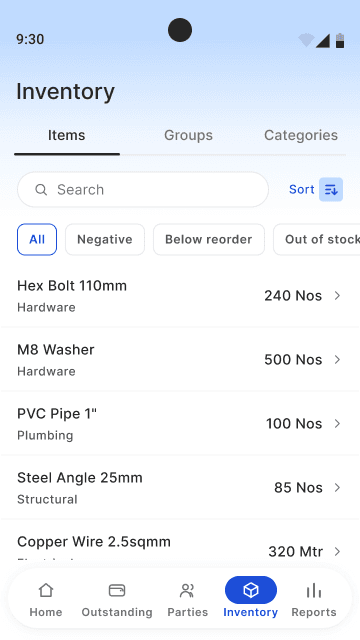
Raw purchase price or quantity wasn’t actionable on its own. Connecting it to stock level, reorder status, and last purchase price is what made it useful — answering “how many left,” “does this need reordering,” “what did I pay last time.”
#3
Parties, for the client-specific deep dive
Supports the moment a customer or supplier calls asking about their own balance, and the moment an owner wants to check one party in detail — separate from the aggregate Outstanding view.

#4
Reports, scoped to depth rather than removed
Day book, P&L, balance sheet, ledgers — kept for users with moderate-to-deep Tally knowledge, rather than simplified into a general-audience feature. A deliberate call not to try to make everything beginner-friendly.

#5
MVP prioritization by cadence, not by feature size
Sales and Outstanding — daily. Parties and Inventory — weekly. Reports — occasional. Expenses and Invoice Creation were deprioritized entirely for v1.
Visual system: one product, six brands
TML owns Quanta but sells through distributors who require their own branding — so white-labeling was a requirement from day one, not a later nice-to-have.
Design principles
Neutral color carries the visual hierarchy
Brand color appears only on interactive elements
A very light brand-tinted gradient sits behind main screens
Scaled with Figma variable modes — one component set, six themes, switchable with no redrawing.
Trust through freshness: multi-company sync
Tally treats each business as a separate “Company,” with its own books and financial year — and owners often run several. Quanta mirrors that: every company is switchable, each with its own sync state.
Because Quanta is a read-only mirror of data that changes constantly in Tally, it’s only trustworthy if the user knows how fresh it is. That shaped two decisions:
A persistent “last synced” status, always visible
Automatic syncing, with manual re-sync always available
Measuring success
I used the HEART framework to define what success would look like post-launch:
Dimension
Goal
How we’d know
Happiness
Users trust the app over calling their accountant
App ratings, reduced accountant reach-outs
Engagement
Owners check it at moments that matter, not just once
Sessions/week, breadth of features used
Adoption
New users get through sync setup to a populated dashboard
Sync-completion rate, time-to-first-value
Retention
Usage holds across monthly business cycles
Repeat sessions, uninstall rate
Task Success
Core tasks (check cash, review payables) complete without friction
Task completion rate, search success rate